HR & talent
Connect recruitment, onboarding, documents, performance and development around each employee. Keep benefits, compensation decisions and departure tasks with the people responsible for following them through.
Explore HR
We selected this market using your approximate location. You can change it anytime. Change country / language · Global site
HR, time & payroll in Ireland
Payrovia brings HR, timekeeping and global payroll together for your business in Ireland and its overseas subsidiaries. One employee record connects your people, with local payroll in each country and visibility across the group.

Local teams and overseas subsidiaries. One platform.
One employee record
Hiring, development, everyday work and the final handover. Keep the employee's history together, so each team has the context to act.
Bring the offer, contract, documents and first-day tasks together. Your local HR and payroll teams start with the same employee information.
Book a demo ↗Give people a place for time records, leave and payslips. Managers see requests in the context of the person's employment.
Book a demo ↗Connect goals, feedback, development and compensation decisions. Give every manager a fuller view of the person behind the next review.
Book a demo ↗Coordinate the handover, equipment, documents and final-pay preparation. Keep the people responsible clear about what is complete and what needs review.
Book a demo ↗Local teams and overseas subsidiaries. One platform.
HR & talent ↗Illustrative product concepts with fictional details.
The Payrovia platform
Bring recruitment, development and employee support together with Irish monthly pay preparation. Keep PPSN, employment dates and approved salary information close to the people reviewing each change.
Connect recruitment, onboarding, documents, performance and development around each employee. Keep benefits, compensation decisions and departure tasks with the people responsible for following them through.
Explore HRConnect working-time and leave information to employee records and payroll review. Agree the available Irish workspace and required approval steps as part of your implementation.
Explore timekeepingPrepare monthly PAYE, USC and supported PRSI Class A1 amounts with employee information available. Agree accounting exports and separate reporting and payment processes before rollout.
Explore local payrollGive employees a place for requests, documents, available payslips and goals. Managers follow approvals and team development with the same employee context available.
Explore employee servicesLocal payroll. Global oversight.
Run your Irish company and overseas subsidiaries on the same platform. Each entity keeps its local payroll requirements, while HR and finance share employee records and review consolidated payroll costs. Start with one company and add countries as your business grows.
Book a demo ↗
See where payroll stands across your companies.
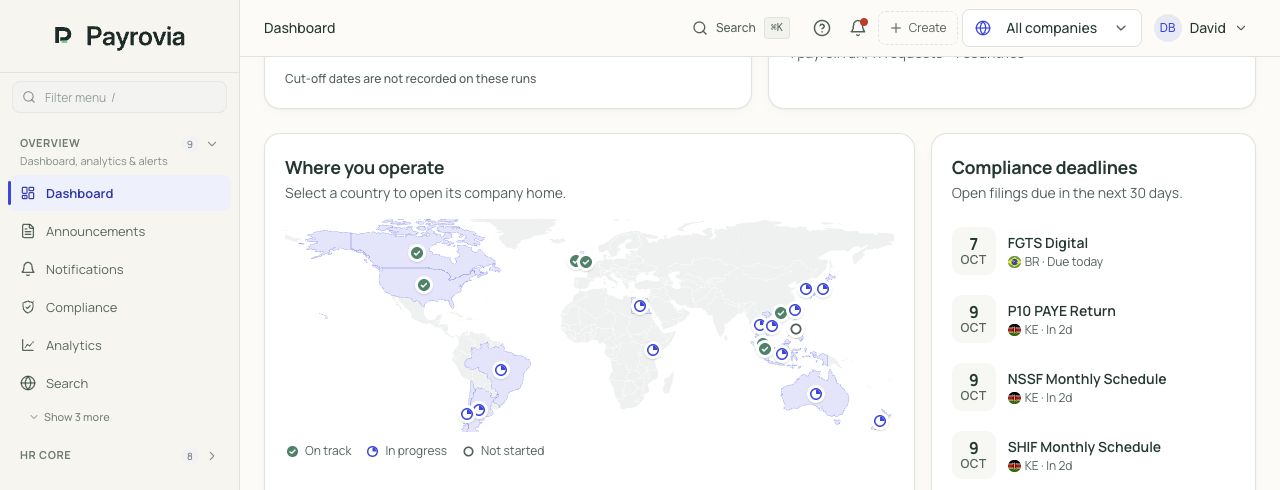
Review headcount, payroll cost, pay dates and open approvals.
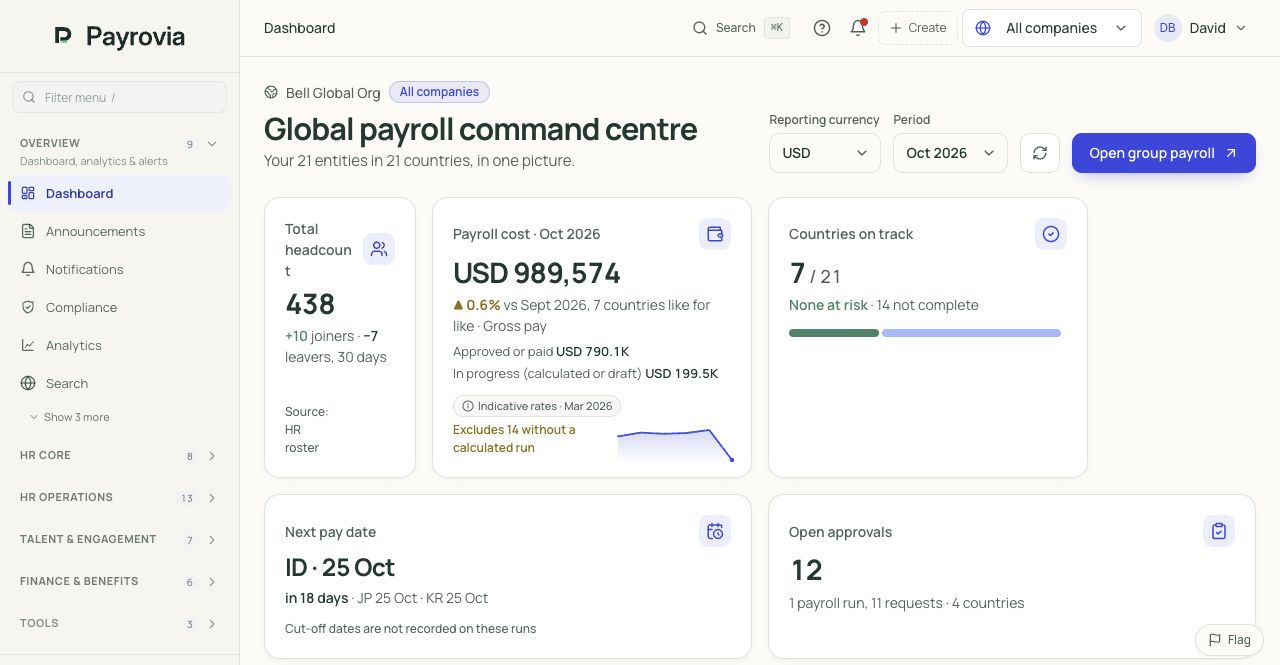
Screens from Payrovia · Bell Global demo data · English interface
The Irish employment record
Revenue's processes rely on accurate employment information, while the Workplace Relations Commission identifies pay, working-time and leave records among the information employers retain. These details also serve an everyday purpose: explaining a payslip, planning time away and helping a manager understand an employee's changing role.
The accepted offer is only the beginning of the payroll handover. PPSN, employment dates and relevant Revenue information need attention alongside the new role. Give HR a record that keeps outstanding setup questions visible while the manager prepares the employee's first week.
An agreed holiday or change in working hours affects the team's plans and the employee's understanding of their leave. Employer-maintained records need to stay connected to job history. Keep the decision and its context available when HR reviews the balance or answers a question.
A monthly payroll total does not explain who joined, whose pay changed or which deduction needs attention. Preserve the employee-level breakdown and the approved employment changes, then give finance a reviewed journal and clear responsibility for the payment and accounting steps that follow.
Everyday Irish employment changes
These examples connect people management with the Irish monthly payroll and accounting workflow.
An Irish business welcomes a colleague midway through the month. The manager is planning induction, HR is collecting employee details, and payroll needs a reliable starting record before preparing PAYE, PRSI and USC deductions.
Keep the accepted offer, PPSN and start date with onboarding documents. Assign missing-information tasks and confirm which person reviews the employee's Revenue-related setup.
Review the first month's working-time information and any agreed absence through the scoped timekeeping process. Resolve questions before the employee enters payroll preparation.
Prepare monthly pay using the reviewed employee information and supported deductions. Check the gross-to-net breakdown so HR can explain the result with its starting context.
What changesThe colleague's first payroll uses the same employment facts as onboarding, and outstanding questions reach an owner before they become a surprise on payday.
An employee agrees a different working pattern while continuing in the same Irish team. The manager wants to maintain service, and HR needs the revised terms and leave information to remain understandable throughout the change.
Keep revised terms, the effective date and the compensation decision with job history. Use the shared HR record to retain the discussion and follow-up actions.
Review the working-time and recorded leave information for the transition. Confirm the relevant balance and keep any question about the new arrangement assigned for review.
Check the agreed gross-pay change and the resulting PAYE, PRSI and USC amounts. Compare the period with the preceding run before approving the outcome.
What changesThe employee's new arrangement remains connected to its pay effect, while the manager can return to the agreed terms and practical coverage discussion.
An Irish company is closing a month with a new starter and an approved salary revision. HR knows why the workforce changed; finance needs payroll figures it can connect to the employee record and the general ledger.
Review the starter information and approved salary decision with the relevant managers. Keep unresolved employee questions visible before the monthly payroll handover is completed.
Check recorded working time and employer-maintained leave for the month. Agree any correction with the responsible reviewer before it affects the gross-pay information.
Review the monthly deduction and net-pay totals, then prepare the general-ledger journal. Keep external payment responsibilities separate from the completion of the payroll calculation.
What changesFinance receives a reviewed accounting handover with the employment changes behind it, while payroll completion remains distinct from actually paying employees.
A local team with room to grow
An Irish team needs more than a record of deductions. The shared HR tools support recruitment, development and employee requests, giving managers a continuing role in the employment relationship and employees a clear place to seek help.
Move candidates through interviews and offers into onboarding tasks. Coordinate documents, equipment and early check-ins with the hiring manager, keeping readiness visible as the employment record takes shape.
Record goals, feedback and one-to-one discussions alongside the employee's history. Use that context for development plans and salary recommendations, with agreed actions that continue beyond the formal review.
Use shared HR service cases to give requests an owner and retain the conversation. Employees and managers can follow questions about documents or workplace arrangements without losing the previous explanation.
Explore the HR workspace
Follow the decisions behind a hire, a review, a pay recommendation and an everyday request. The employee record carries the context between teams.
Keep the vacancy, interviews and offer together. Carry the new colleague into onboarding, with documents, equipment and tasks assigned to the right people.
The hiring decision becomes the start of the employee record.
One hire. A shared plan for HR, the manager and the new colleague.
Connect goals, regular feedback, review cycles and development plans. Give the next manager the history behind a person's progress, with appropriate access.
A review leads to a useful next step, with an owner and follow-up.
Goals, review history and future opportunities stay connected.
Review salary recommendations alongside budgets, employee history and benefit choices. Record the approval before the change reaches the relevant payroll period.
HR and finance can explain what changed, when and why.
Illustrative recommendation. No salary change is submitted by this screen.
Connect HR requests, documents and employee services to the person. Keep a clear owner, status and response history so a question survives a departmental handover.
The employee sees progress. HR sees the context needed to respond.
Access follows the role. Sensitive case details stay with authorised people.
Illustrative product screens · fictional records and amounts
Useful to everyone
Make the employee record part of daily work. Employees, managers and HR participate through the information and actions relevant to their role.
Employees request leave, find documents, read available payslips and follow goals, with everyday HR questions connected to their employee record.
Managers review requests, approve relevant changes and follow team goals, with employee history available when a decision needs more context.
Illustrative product screens · fictional records and amounts
Irish payroll preparation
Prepare Irish employee and employer information, review the local deduction breakdown and carry the results into accounting. Agree the precise workspace, reporting and external payment scope before your first live cycle.
Explore payrollPrepare monthly income-tax and Universal Social Charge calculations with maintained employee information. Review the applicable tax setup and current Revenue requirements with the person responsible for payroll.
Review supported Class A1 employee and employer PRSI amounts alongside earnings. Confirm the required employee classes during scoping rather than assuming every Irish employment category is covered.
Maintain PPSN, employment type and start or end dates with the employee record. Capture CRO and Employer PAYE registration information so local setup has a clear point of reference.
Prepare payslips showing the PAYE, PRSI and USC breakdown, with payroll results available for general-ledger journal preparation. Agree the accounting export and period-close review your finance team needs.
Inside the payroll review
Choose a situation. Follow the source information into an illustrated payslip, then see the checks before release. Local treatment stays with the country and employee.
Compare time with the roster and the approved request. Keep the earning separate so payroll and the employee can follow its source.
Illustrative pay period · EUR
Employer costs · separate from net payEUR 280
Check the hours and supporting request.
Review the applicable local treatment.
Approve the payroll version before release.
Prepare monthly income-tax and Universal Social Charge calculations with maintained employee information. Review the applicable tax setup and current Revenue requirements with the person responsible for payroll.
Carry an approved salary change from HR into the right period. Retain the earlier amount and the explanation behind the difference.
Illustrative pay period · EUR
Employer costs · separate from net payEUR 280
Confirm the approved employee change.
Check dates, proration and any earlier periods.
Explain the variance before finalising.
Review supported Class A1 employee and employer PRSI amounts alongside earnings. Confirm the required employee classes during scoping rather than assuming every Irish employment category is covered.
Review employee deductions individually. Keep the employer's costs separate, with the approved basis for any repayment visible.
Illustrative pay period · EUR
Employer costs · separate from net payEUR 280
Review tax and contribution inputs.
Check the authorised deduction or repayment.
Reconcile balances and employer costs separately.
Maintain PPSN, employment type and start or end dates with the employee record. Capture CRO and Employer PAYE registration information so local setup has a clear point of reference.
Bring leaving dates, remaining pay and applicable settlement items together. Keep clearance, calculation approval and payment responsibilities distinct.
Illustrative pay period · EUR
Employer costs · separate from net payEUR 280
Confirm dates and locally applicable amounts.
Review leave and outstanding obligations.
Authorise settlement and follow the payment outcome.
Prepare payslips showing the PAYE, PRSI and USC breakdown, with payroll results available for general-ledger journal preparation. Agree the accounting export and period-close review your finance team needs.
Teaching example only. These are not statutory rates, a quotation or a live payroll calculation. Pay frequency, tax, contributions and final-pay treatment must be confirmed locally.
EOR arrangements
For an Irish employing entity or separately contracted provider, Payrovia's central agreement and billing tools can form part of a wider operating arrangement. Confirm the Irish workflow and client access separately: a dedicated local EOR workspace is not included. Automatic Irish payroll reconciliation and statutory-cost coverage are not established by central billing, and Payrovia is not the legal employer.
Define the client, employing entity or provider, countries, fees and responsibilities. Connect each person to the arrangement under which they work.
Define the client, employing entity and provider relationships.
The agreement names the parties and responsibilities; software does not become the legal employer.
Bring HR records, leave, benefits and payroll coordination into the assignment. Give clients access to the information and approvals you have explicitly agreed.
Review centrally agreed assignment costs, fees and invoice records.
Local payroll connections and employer-cost coverage are confirmed for your arrangement.
Review employment costs, agreed fees and adjustments by client and period. Keep the supporting assignment detail beside the draft invoice.
Confirm local tasks and access before including Ireland in the arrangement.
Illustrative USD invoice, not Payrovia pricing. FX evidence, tax, credits and settlement need their own review.
Illustrative EOR workflow. Availability of local connections and automated reconciliation is confirmed separately.
Why teams choose Payrovia
Recruitment, onboarding, performance, development, succession, compensation, benefits and employee services—around the same record.
Connect employee changes, approved time and leave to local payroll review. Give reviewers the information behind the result.
Run one company or connect overseas subsidiaries. Keep local payroll requirements visible while finance reviews the wider business.
Explore the product and detailed features, review pricing and security, or see how implementation works. Book a demo to discuss your people, countries and first rollout.
No. Confirm the current Revenue Payroll Notification and payroll-submission process, credentials, required information and review ownership during setup. Irish monthly calculation support does not establish end-to-end acceptance by Revenue. We assess your actual reporting workflow before rollout, including how starters, changes and leavers are handled.
The declared Irish payment output is a general-ledger journal export. Employee disbursement is handled outside Payrovia through your separately agreed payment process. Finance must distinguish preparing the net-pay figures and recording an accounting handover from authorising, funding and completing salary payments through its chosen provider or bank.
Irish leave balances and employer-recorded leave are available, but a local employee request-and-approval lifecycle is not provided. Agree how managers and employees request time away, then maintain the confirmed leave record through the scoped process. Shared HR cases can support questions and discussion without implying an Irish leave-approval feature.
No. Shared HR remains available, while the Irish workspace has a narrower local scope. Dedicated imports, reports, certificates, time reconciliation, hour banking, annualisation, statutory-rate, separation and EOR screens are not included. We demonstrate the actual Irish workflow and agree any necessary external handoffs before implementation.
A walkthrough for your business
Tell us about your local team and any overseas subsidiaries. We'll focus the demonstration on the HR, timekeeping and payroll work you want to improve.